

The network revolutionary: How Brendan O’Brien is rewiring the internet with n0
Builders for Human Agency #1: b5

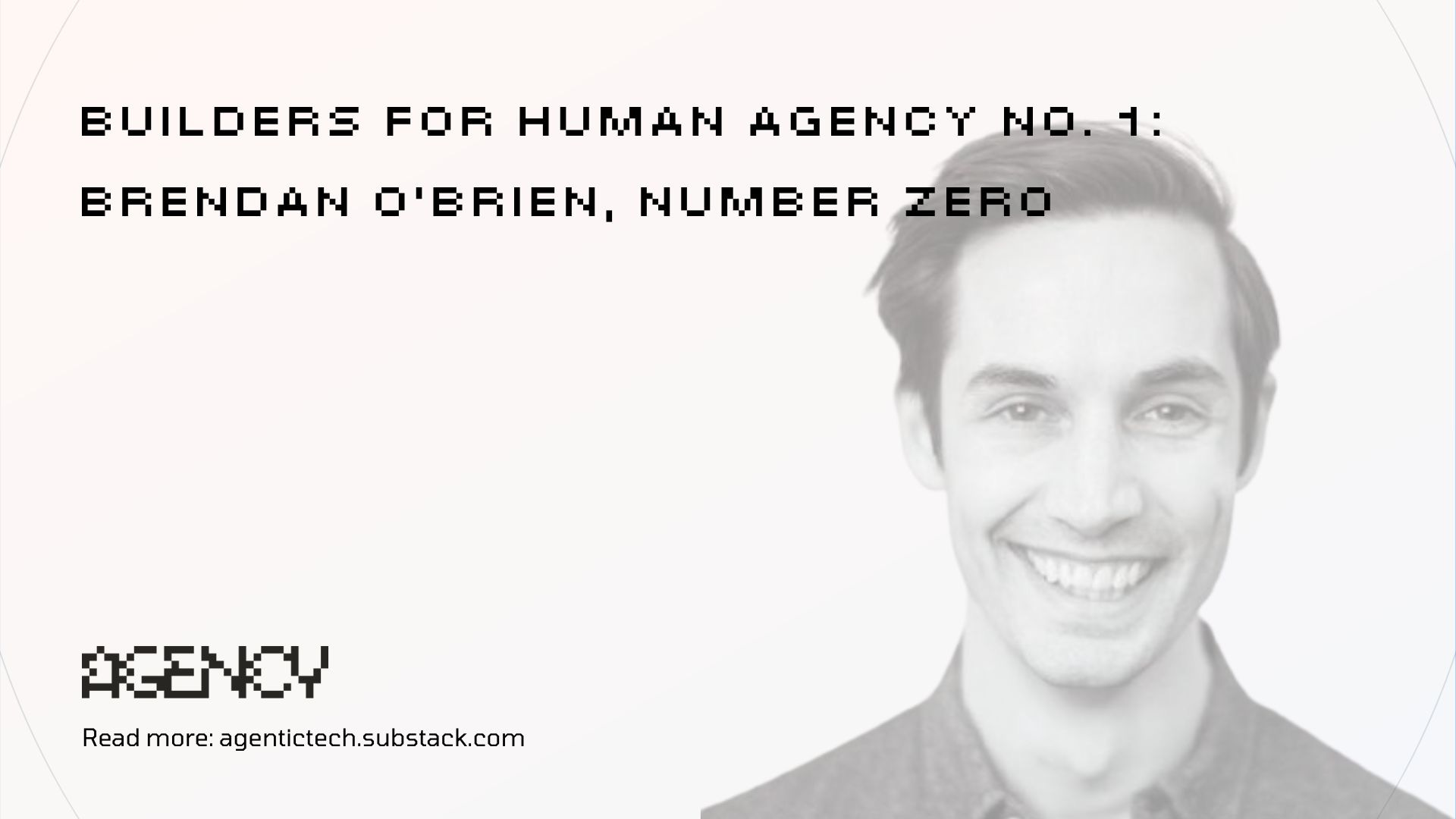
In 2016, as rumors swirled that the incoming presidential administration might shut down access to government websites, O'Brien—also known as b5—joined a project called Data Rescue. The mission: preserve critical climate datasets from the EPA before they would potentially disappear. This work connected him to the early developers of IPFS, a project reimagining how data moves across the internet.
"They had this belief that the design of the internet is wrong," O'Brien explains. "If we referred to data by its hash instead of its location, we wouldn't have to worry about suppression of knowledge. We could move data seamlessly from one place to another."
Architecting the internet in this way represents “a better deal for users," O'Brien says, leaning forward. It's a phrase he returns to repeatedly—a north star guiding his peer-to-peer networking company, n0 (Number Zero).
O'Brien didn't set out to revolutionize internet infrastructure. He "fell into tech sideways" through graphic design, discovering a love of programming when he started learning HTML and CSS.
But it was the political climate of the mid-2010s that transformed his relationship with technology. And it led him deeper into understanding of "how much protocols and politics are commingled."
Beyond decentralization
What separates O'Brien from many of his peers is his focus on outcomes rather than ideological purity. While many technologists fixate on decentralization as an end itself, O'Brien has a different approach:
"When asked a hard question like 'Is this making the world a better place?' the human mind substitutes an easier question: 'Is this decentralized?'" he observes. "But decentralization might get you agency, or it might not. If you focus on agency, you will definitely get agency."
This perspective shapes n0's development of Iroh, a protocol that creates direct connections between devices. Iroh powers everything from video streaming and gaming to secretive communications in places where internet access is heavily surveilled or restricted. One of their most notable collaborations is with Delta Chat, which operates in places like Iran and Cuba—regions where "even touching specific IP addresses, going to visit specific websites will get you put on a list." In these precarious contexts, the Iroh protocol becomes a lifeline.
The beauty of n0’s technology is its broad applicability–-beyond restricted internet zones, Iroh is deployed in applications that serve millions of people worldwide, with its impact particularly visible in challenging network environments.
"We have Rave, Cooley, SpaceDrive, Ramo, and Delta Chat," O'Brien shares. "These are apps and software used and indirectly relied upon by millions of people."
"We're on tens of millions of devices," O'Brien notes. "The biggest peak daily active network we've seen has had more than 200,000 concurrent users at the same time."
Unlike many founders in emerging tech spaces, O'Brien isn't interested in rebuilding everything from scratch or forcing users to change their behavior. "The protocol needs to meet the people where they are," he insists. "You don't need to ask yourself if it's perfectly decentralized. You need to ask if it's increasing the agency of the user."
Resilience by design
Inside n0's expansive workshop, engineers test drones that incorporate the Iroh protocol. What makes the technology special is its resilience. Even if your internet connection is cut off, your device can still talk to nearby devices.
O'Brien walks a careful line between idealism and pragmatism. While Iroh is fully open-source, n0 also provides cloud services to ensure "there's always a peer online that you can talk to." Some purists might call this a compromise, but O'Brien is focused on results: "If we're using the 'is it decentralized' stick, what we're doing is wrong. But if we use the 'is it increasing the agency of the user' lens, what we're doing is a massive net benefit."
Building the “cozy web”
Looking ahead, O'Brien identifies a significant shift in how people use the internet—what he refers to as "the cozy web," using Venkatesh Rao’s term for the more intimate digital spaces that users are gravitating toward.
"People are spending way more time in WhatsApp groups, Telegram groups, Discord servers—places where they're cozier with people they know," he explains. "I think you'll see a heightening of cozy software intended to be deployed into these places, with a reasonable guarantee that it won't phone home."
This shift could fundamentally change how software is built and distributed: "It revives the older ownership model of software—just pay that software dev five bucks for that version, no subscription, one-time fee."
For this vision to work, however, peer-to-peer technology is essential. "That's why we think peer-to-peer is the only way you get that lovely combination of cozy groups, delivering software to them, where they can have a network experience without needing a central authority."
The competitive advantage of agency
O'Brien believes that other founders are underestimating user agency as a strategic advantage.
Take the cases of WhatsApp and Signal—both end-to-end encryption (E2EE) messaging apps, meaning only senders and recipients can control their correspondence. These businesses, O’Brien noted, have carved out tens of millions strong audiences on what we would now call user agency. "Not everybody is consuming WhatsApp or Signal for that reason, but almost everybody turns to the smart geeky person in their life and asks what they use."
These technically-savvy users become quiet tastemakers, steering friends and family toward tools that offer better privacy guarantees. O'Brien sees this as a playbook for competing with entrenched platforms.
"If you want to compete with TikTok today, you should think carefully about how you get a user agency advantage," he suggests. "You're doing a thing TikTok won't be willing to do—keep data at the edge, not move it toward some central place."
As our conversation winds down, O'Brien returns to his core belief: that giving users more control is a fundamentally good business practice—not just a moral decision. "Young people launching apps today should be thinking carefully about how to provide a better contract to users," he says. "How do I make 'going dark' into an advantage? It's defensible, scalable, and monetizable."
In a tech landscape dominated by AI hype cycles and venture capital frenzies, O'Brien's approach is refreshingly grounded. Rather than chasing abstract concepts, he's focused on building technology that lets people connect directly, securely, and on their own terms.
The result is a vision for how the internet could work differently. And tens of millions of users are already experiencing it, one direct connection at a time.
n0 is creating resilient internet infrastructure that puts users in control. Their Iroh protocol is being used by applications serving millions of people worldwide.
In Builders for Human Agency, we chronicle the entrepreneurs creating the next generation of viable business models in tech that augment human capabilities, safeguard digital rights and liberties, and shift power back into the hands of users. Learn how you can join our movement and subscribe today.